
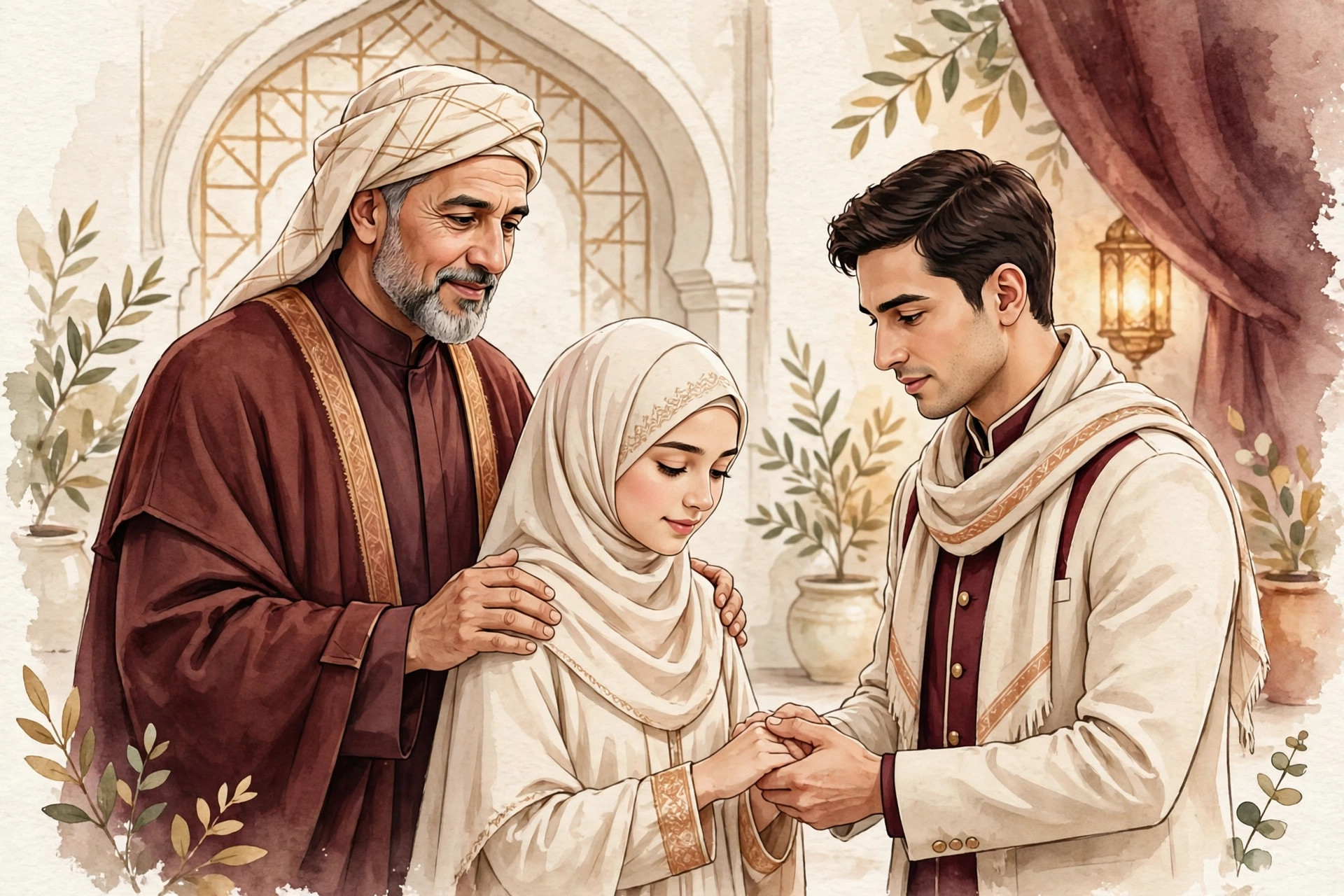
The Role of the Wali, Explained Simply
For many families, the wali is one of the least understood parts of the marriage process — and one of the most important. Some treat it as a formality: Dad signs a paper, the nikkah happens, everyone goes home. Others treat it with fear: “What if my wali won’t approve?” Both views miss the point.
The wali — usually a father, but the role can pass to a grandfather, brother, uncle, or another male relative in a defined order — is not a barrier between a woman and marriage. He is her advocate. Understanding this role clearly brings calm to the whole process, because it tells everyone what their part actually is.
What a Wali Is — and What He Isn’t
At its simplest: the wali is the bride’s guardian representative in the marriage contract. Many scholars hold that a marriage contract needs a wali to be valid, and families across the world arrange the nikkah through him.
What he isn’t: the owner of the decision. A woman’s consent is her own — many scholars are clear that a marriage without her agreement is not valid. The wali’s job is not to choose for her. It is to protect her interests while she chooses, and to give the contract its proper Islamic form.
Think of him less like a gatekeeper and more like a trusted advisor with a signature that means something.
Why the Role Exists
Marriage is the biggest commitment most people will ever make, and it deserves witnesses, structure, and the involvement of people who love you. The wali requirement ensures that a woman does not enter this covenant alone, pressured in a moment, without the support and due diligence of her family.
It also anchors the marriage in community. A marriage witnessed and supported by family is harder to rush, harder to hide, and easier to sustain. The wali connects the private choice to the public, dignified framework Islam asks for — a marriage that is announced, witnessed, and backed by the people who will support the couple through hard times.
What a Good Wali Actually Does
In practice, a good wali does four things:
He investigates. The wali asks the hard questions of the suitor and his family — about character, deen, work, habits, and how he treats people. He checks references. He listens to his daughter’s own observations. This isn’t distrust; it’s diligence. A good wali would not hand his daughter to a stranger, so he makes sure the suitor is not one.
He advises. A father who has lived longer has seen more. His role includes sharing wisdom his daughter may not have — red flags that only show with time, questions she hadn’t thought to ask. The key word is advising. Many scholars advise that a wali should not force a marriage against the woman’s will; his influence is meant to be guidance, not control.
He represents her at the contract. At the nikkah, the wali typically gives her in marriage and the terms are set in his presence — including the mahr. His presence ensures the contract is sound, the terms are fair, and everything is clear to both sides.
He remains her safety net. After the marriage, the wali’s role does not vanish. He is someone she can turn to if things go wrong. The wali system means a woman enters marriage knowing her family stood with her at the start — and will stand with her if needed.
When the Wali Is Missing or Unwilling
Real life is complicated. Sometimes a woman is a convert with no Muslim male relatives. Sometimes her father is absent, estranged, or — painful as it is — refuses without good reason.
Islamic guidance has answers for these situations. A woman without a wali is not left stuck: many scholars say an imam, a qadi, or another trusted Muslim man in the community can serve as her wali. And when a wali refuses a suitable proposal for no valid Islamic reason, scholars generally advise that she can seek the help of an imam or religious authority to step in — the role cannot be used as a veto against her wishes.
If this is your situation, talk to a trusted, knowledgeable imam early. Do not let a difficult family situation quietly stop your search, and do not marry secretly to work around it. There is a halal path through every version of this, and finding it with proper guidance protects everyone involved.
For Fathers: Taking the Role Seriously
If you are a father, this role may come to you someday. Treat it with the weight it deserves — and the gentleness it requires.
Taking it seriously means doing the due diligence your daughter deserves, setting fair terms, and making sure the contract is done properly. Taking it gently means remembering that the decision is hers. Your job is to make sure she chooses well, not to choose for her.
The fathers who do this best are the ones who talk openly with their daughters — who know what she values, who listen as much as they instruct, and who make her feel that her wali is her strongest advocate, not her biggest obstacle. When she trusts that you are on her side, she will actually want your counsel. That is far more powerful than any authority.
For Single Women: Your Voice Matters
And to the single women reading: the wali does not erase you from your own marriage story. You are at the center of it. Ask questions, meet the family, take your time, pray istikhara, and say clearly what you think and feel.
A wali who respects you will welcome that. A good wali and a confident bride are not in tension — they are the two pillars of a marriage that starts right.
Dignity From Start to Finish
The wali is, at its heart, an act of love built into the structure of marriage itself. It says: you are precious enough that the most important contract of your life should be witnessed, supported, and guided by someone who has protected you since you were a child.
When everyone understands the role — the wali as advocate, the woman as decision-maker, the family as support — the whole process becomes what it was meant to be: organized, dignified, and deen-first.
Searching for a spouse the dignified, organized way? MuslimMatchByParents.com connects serious families with real profiles — parent-led, deen-first, and built for how our community actually finds matches. Lifetime access for a $29 one-time payment. No monthly fees, ever.

